

What Are Hot-Extruded Steel Sections? Manufacturing Process, Benefits, Applications, and Cost Reduction
- Product
- Hotextruded
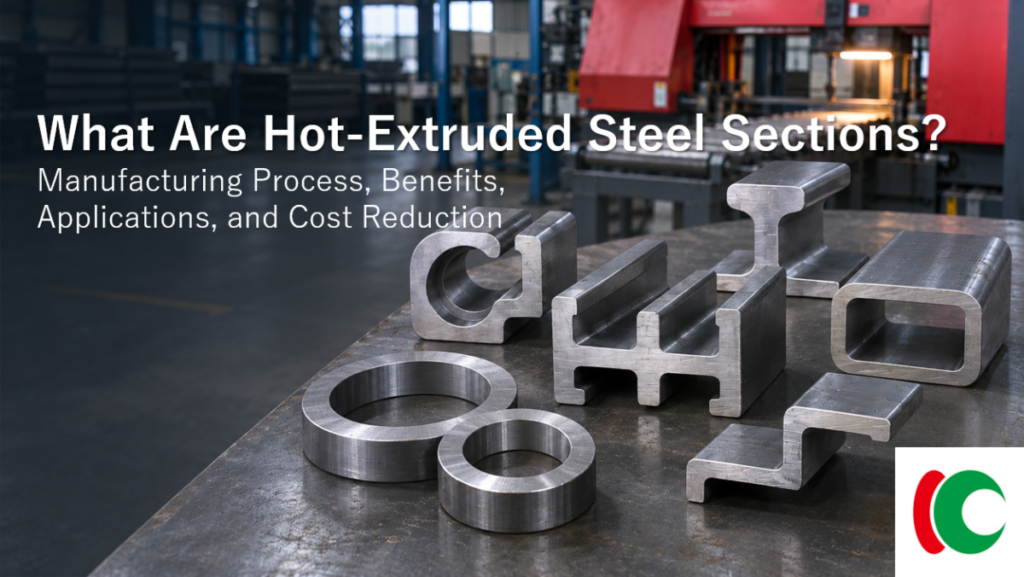
Learn about hot-extruded steel sections, including their manufacturing process, advantages, available materials, cross-sectional designs, and applications. Discover how hot extrusion can reduce machining and welding operations, improve material yield, and lower overall manufacturing costs.
目次
Hot-extruded steel sections are produced by forcing heated steel through a specially designed die to create a continuous, uniform cross-sectional profile.
Unlike conventional rolled steel sections, hot extrusion allows manufacturers to produce complex, customized profiles that may otherwise require extensive machining or the welding of multiple components.
By replacing these conventional manufacturing methods with one-piece forming, manufacturers may reduce processing steps, improve material yield, and lower overall production costs.
However, hot extrusion is not necessarily the most economical solution for every application. Factors such as die costs, material grades, production quantities, dimensional tolerances, and secondary processing requirements must all be considered.
This article explains the manufacturing process, key advantages, applications, and important considerations when evaluating hot-extruded steel sections.
1.What Are Hot-Extruded Steel Sections?
1-1. Steel Sections Manufactured Through the Hot Extrusion Process
Hot-extruded steel sections are manufactured using a process known as hot extrusion.
According to Nippon Steel, round steel billets are heated to approximately 1,200°C and then forced through specially machined dies to produce the desired cross-sectional profiles.
After extrusion, the steel sections undergo cooling, straightening, cutting, inspection, and other finishing operations as required.
Because the opening of the die determines the cross-sectional shape of the product, hot extrusion is particularly suitable for producing long steel sections with consistent profiles along their length.
Depending on the design and manufacturing conditions, both solid and hollow cross-sectional profiles may be considered.
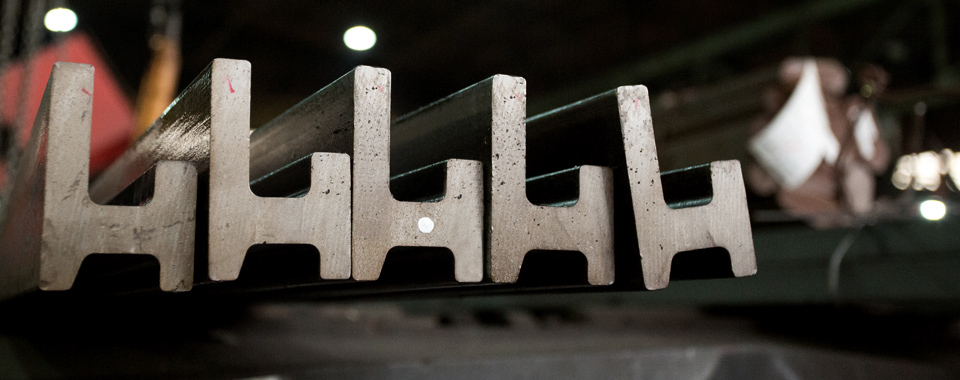
Unlike conventional rolled sections, which generally use standardized profiles, hot-extruded steel sections offer greater flexibility in designing customized cross sections for specific applications.
1-2. Are Hot-Extruded Steel Sections and Hot-Extruded Shapes the Same?
The terms hot-extruded steel sections and hot-extruded steel shapes generally refer to steel products manufactured using the hot extrusion process.
In this article, we use the term “hot-extruded steel sections” consistently.
1-3. Differences Between Hot-Extruded and Conventional Rolled Steel Sections
Conventional steel sections, such as H-beams, channels, and angles, are typically manufactured by passing heated steel through a series of rolling mills.
These processes are well suited to mass production of standardized cross sections.
However, producing specialized or complex profiles by rolling may require substantial roll design and tooling.
Hot extrusion uses a specially designed die, making it possible to consider more complex cross sections, customized profiles, and a wider variety of product designs.
2. Manufacturing Process of Hot-Extruded Steel Sections
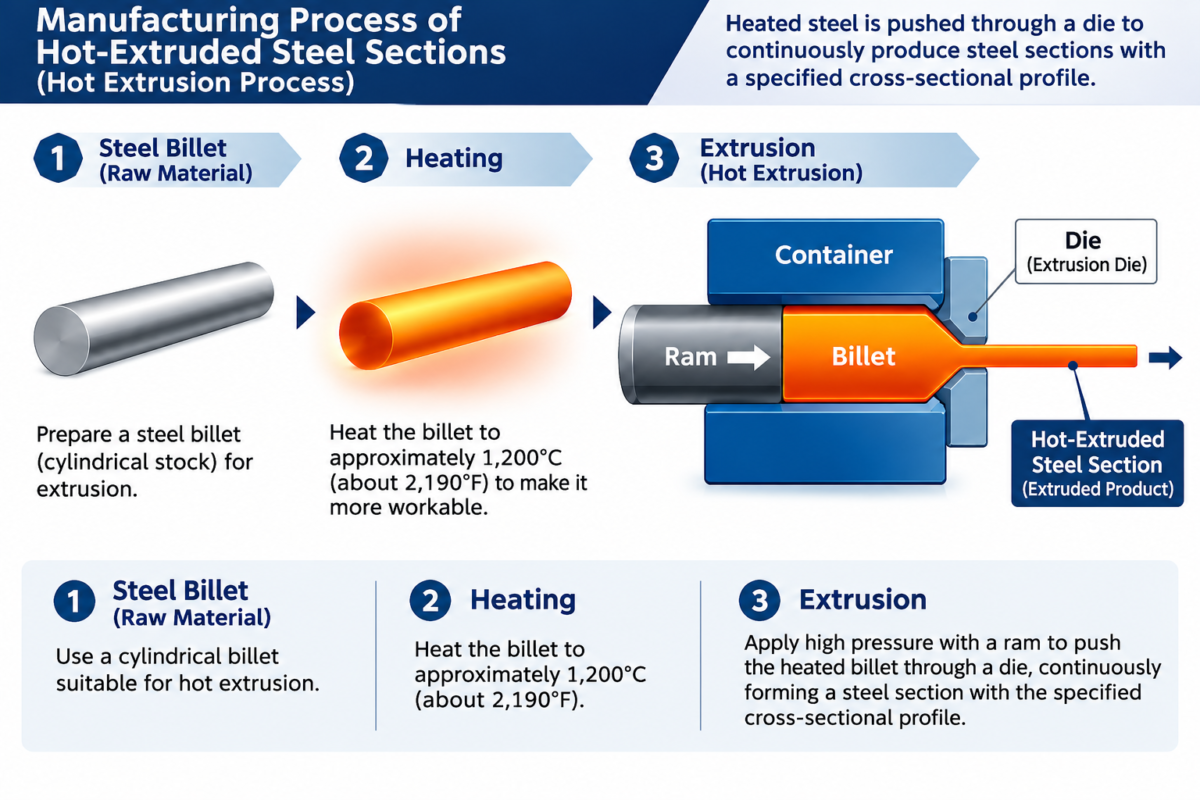
Round Billet (Raw Material)
High-quality round steel billets optimized for extrusion are prepared. A wide range of steel grades can be selected, including carbon steel, low-alloy steel, structural steel, and stainless steel.
Induction Heating
The billet is uniformly heated to approx. 1,200°C (2,192°F). This softens the metal structure, ensuring optimal plasticity and workability required for hot plastic forming.
Hot Extrusion
Loaded into a high-pressure container, the red-hot billet is forced through a dedicated tooling die by a heavy-duty hydraulic ram, producing complex, seamless steel shapes in a continuous single pass.
After being formed into near-net shapes via hot extrusion, the profiles undergo cooling and straightening, followed by secondary machining such as cutting, drilling, and surface milling as required.
3. Key Features and Advantages of Hot-Extruded Steel Sections
3-1. Complex Cross-Sectional Profiles Can Be Formed as a Single Piece
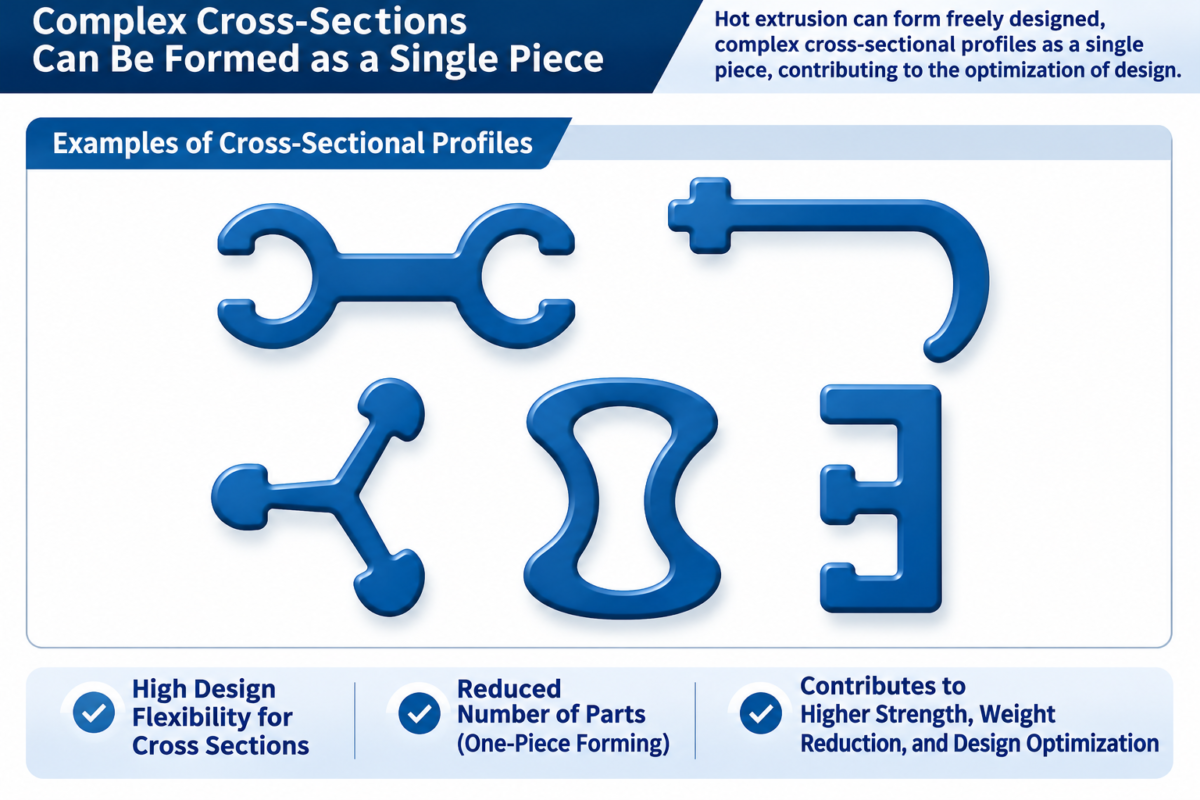
【Available Cross-Sectional Geometries & Profile Variations】
Geometries that are virtually impossible to manufacture through conventional roll forming—such as asymmetrical contours and hollow sections—can be extruded seamlessly in a single pass using dedicated tooling dies[cite: 6]. This approach enables optimized cross-sectional design tailored to specific functional requirements and stress distributions[cite: 6].
Combines the structural rigidity of hollow sections with complex outer shapes, achieving high rigidity and weight reduction[cite: 6].
Integrates guide rails, mounting hooks, and engagement grooves directly into the shape, reducing secondary machining[cite: 6].
Integrates continuous reinforcing ribs to prevent stress concentrations without requiring multi-pass welding[cite: 4, 6].
High Design Flexibility (Near-Net-Shape)
Part Count Reduction (Monolithic Structure)[cite: 4, 6]
Optimized Strength & Weight Ratio[cite: 6]
Hot-extruded steel sections can potentially be formed into complex, one-piece profiles that are difficult to manufacture through conventional rolling processes, including asymmetric shapes, grooved profiles, and sections with varying wall thicknesses.
By designing cross sections that strategically distribute material where it is needed, manufacturers may be able to reduce the number of components and optimize weight while maintaining the required functionality.
For architectural applications, hot extrusion also offers the advantage of creating customized cross-sectional profiles that combine structural performance with aesthetic design.
3-2. Reduced Machining Operations and Material Waste
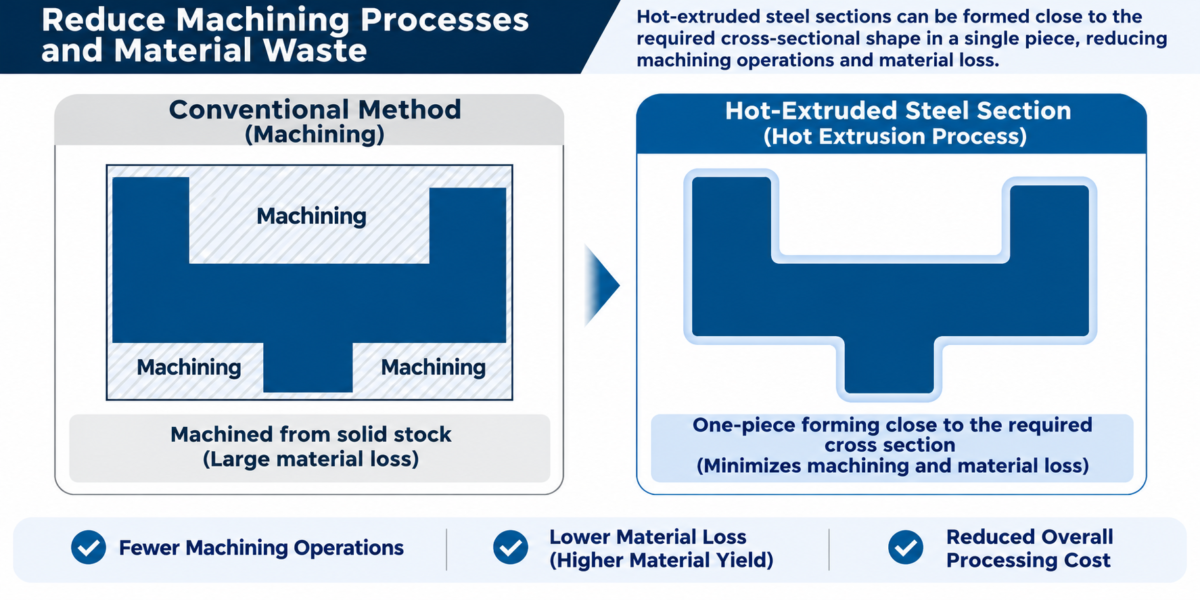
Machining Hours Reduction (Faster cycle time)[cite: 3]
Material Scrap Minimization (High yield)[cite: 3]
Total Fabrication Cost Savings[cite: 3]
3-3. Reduced Welding and Distortion-Correction Operations
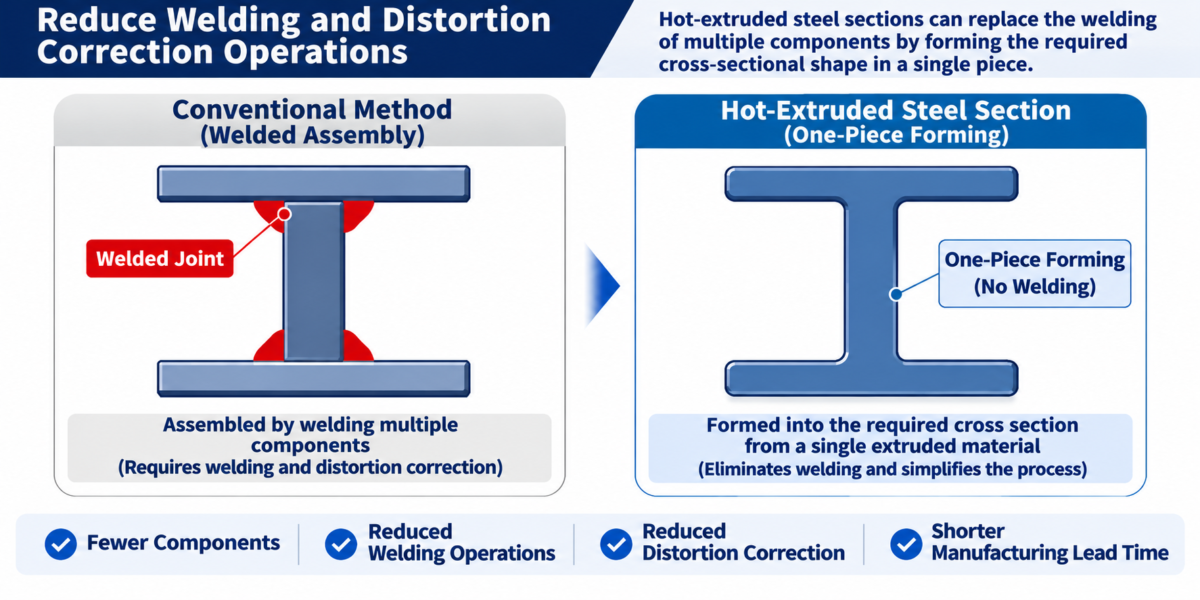
Part Count Reduction (Consolidated BOM)[cite: 4]
Welding Pass Elimination (Lower labor costs)[cite: 4]
Distortion-Straightening Zeroed[cite: 4]
Manufacturing Lead Time Shortened[cite: 4]
Note: Reducing the number of welded joints can also help reduce the workload associated with weld quality control and inspection. However, compliance with the required strength specifications and applicable standards must be verified on a case-by-case basis, taking into account the specific design requirements.
3-4. Suitable for Product Variety and Design Changes
According to Nippon Steel’s technical catalog, tooling costs (extrusion dies) for the hot extrusion method are substantially lower than conventional roll-forming tooling, making small-lot production starting from as low as 1 metric ton feasible.
Please note that actual order feasibility and minimum order quantities (MOQ) depend on the steel grade (carbon, low-alloy, or stainless steel) and order recurrence (recurring vs. one-off production runs).
| Steel Grade | Recurring Run | One-Off Run |
|---|---|---|
| Carbon & Low-Alloy Steel | 1 ton / run | 5 tons |
| Stainless Steel | 0.2 tons / run | 1 ton |
* Production terms and minimum lots are subject to profile complexity, dimensions, and alloy specifications. Please consult us for exact feasibility.
Note: Minimum production lot sizes and economically viable order quantities may vary depending on the material grade, cross-sectional profile, product length, production schedule, and other manufacturing conditions. Rather than evaluating feasibility based solely on order quantity, it is important to discuss the expected annual consumption and duration of ongoing demand.
3-5. Various Steel Grades Can Be Considered
Hot extrusion can be applied to various categories of steel, including carbon steel, alloy steel, high-strength steel, and stainless steel.
Kumagai Specialty Steel offers consultations on a range of materials, including ordinary structural steel, carbon steel, high-tensile steel, and stainless steel.
Actual manufacturing feasibility depends on the combination of material grade, cross-sectional geometry, and production requirements.
4. Comparison with Conventional Manufacturing Methods
| Comparison Criteria | Machining from Solid | Welded Fabrication | Hot Extruded Shapes |
|---|---|---|---|
| Cross-Section Forming | Hogged out / milled from thick solid plates or bars | Joining multiple plates and standard structural sections via welding | Forced through a custom die for seamless monolithic forming[cite: 1, 4] |
| Material Yield | Yield drops significantly when producing profiles with heavy chip removal | Varies substantially depending on plate nesting and cutting layout | High yield achieved by forming close to final geometry (near-net-shape) |
| Primary Operations | Rough milling, semi-finishing, and final machining passes | Cutting, beveling, fitting, welding, and distortion straightening[cite: 1, 4] | Hot extrusion followed by cooling, straightening, and optional secondary machining |
| Tolerance & Precision | High dimensional accuracy and fine surface finishes achievable directly | Requires strict compensation for thermal distortion and shrinkage[cite: 1, 4] | Secondary machining can be added selectively to tight-tolerance mating surfaces |
| Best-Fit Applications | Low-volume prototypes, ultra-precision parts, and frequent design revisions | Extra-large structures and profiles with longitudinal cross-section variations | Long structural lengths with continuous uniform cross-sections, complex profiles, and recurring production[cite: 1] |
| Key Feasibility Factors | Machining cycle hours and raw material scrap volume[cite: 1] | Weld integrity, NDT inspection costs, and straightening labor[cite: 1, 4] | Tooling die amortization, production lot sizes, and secondary machining scope[cite: 1] |
Engineering Guideline: The optimal fabrication method depends on cross-sectional geometry, production volume, required tolerances, steel grades, delivery schedules, and secondary processing requirements[cite: 1]. Rather than evaluating hot extruded steel in isolation, it is critical to compare total component lifecycle costs—including material utilization, labor hours, and total fabrication lead time[cite: 1].
5.Products and Profiles Suitable for Hot Extrusion
Hot extrusion may be worth considering for components with the following characteristics:
- Components with a consistent cross section along their length
- Parts requiring extensive material removal through machining
- Welded assemblies involving multiple components
- Products requiring customized profiles unavailable as standard rolled sections
- Repeat-production components for which tooling costs can be justified
- Architectural components requiring both structural functionality and customized appearance
On the other hand, conventional manufacturing methods may be more suitable for products with significantly changing cross sections, extremely small one-time orders, or components requiring extensive precision machining after extrusion.
Evaluating the existing manufacturing method and the required final specifications is the first step in determining whether hot extrusion is appropriate.
6. Main Applications of Hot-Extruded Steel Sections
6-1. Industrial Machinery and Material-Handling Equipment
Hot-extruded steel sections are used in various industrial applications, including guide rails, sliding components, specialized machine parts, and forklift mast components.
Their ability to incorporate grooves, projections, and other functional features into a single cross section may help reduce assembly operations and secondary machining.
6-2. Architectural and Civil Engineering Components
Potential applications include architectural fasteners, window frames, handrails, and customized structural or decorative sections.
Hot extrusion provides flexibility when conventional standardized steel sections cannot meet specific design requirements.
When used for structural applications, relevant material standards, design codes, certification requirements, and welding conditions must be verified.
6-3. Raw Material for Mass-Produced Components
Hot-extruded steel sections can also be used as intermediate materials for mass production.
For example, a long steel section with a consistent cross section can be sliced into multiple identical components.
Depending on the product geometry, this approach may reduce material waste and machining operations compared with producing each component individually from steel plate.
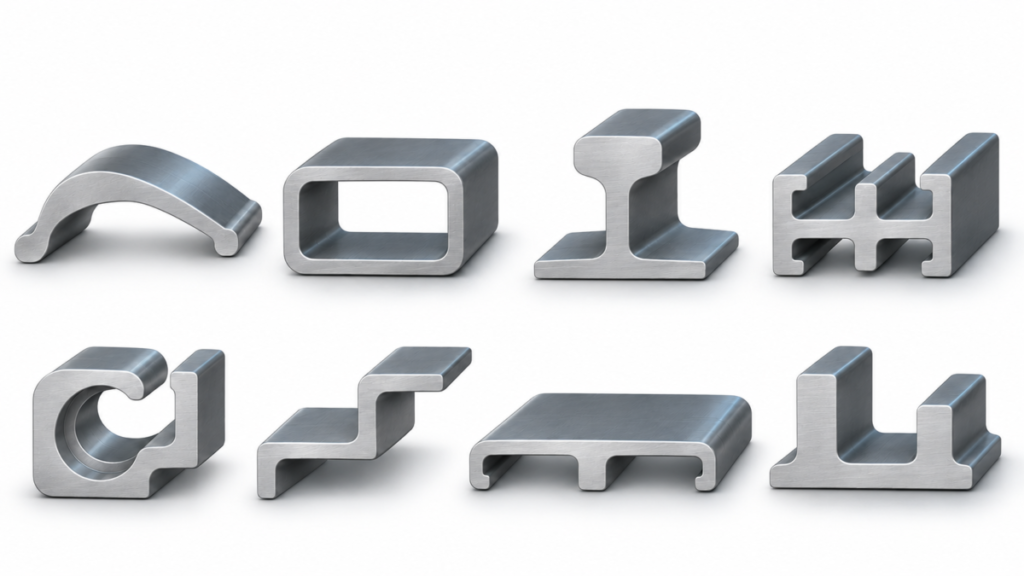
Illustrative examples of complex cross-sectional profiles that may be considered for hot extrusion.
Note: These illustrations are conceptual representations independently prepared with reference to publicly available manufacturer information. They do not represent standard products, confirmed manufacturing capabilities, or production records of any particular manufacturer. Actual feasibility depends on material grade, geometry, dimensions, tolerances, production quantity, and other manufacturing conditions.
7. Material Grades, Cross-Sectional Designs, and Dimensions
7-1. Material Grades
Potential materials include ordinary structural steel, carbon steel, high-strength steel, stainless steel, and alloy steel.
However, not every material grade can be manufactured in every cross-sectional configuration.
Important selection factors include required strength, corrosion resistance, weldability, heat-treatment requirements, and operating environment.
7-2. Cross-Sectional Geometry & Dimensions
While hot extrusion provides extensive geometric freedom, specific manufacturing parameters apply[cite: 6, 7]. The baseline feasibility guidelines specified in Nippon Steel’s technical catalog are summarized below.
| Parameter | Manufacturing Feasibility Guidelines |
|---|---|
| Max. Circumscribed Circle (CCD) | φ215 mm (approx. 8.46 in) |
| Min. Wall Thickness | 8 mm (0.31 in) *down to 6 mm (0.24 in) depending on profile geometry |
| Corner Radii | Convex: r ≥ 2 mm (0.08 in) / Concave: R ≥ 5 mm (0.20 in) |
| Cross-Sectional Area | 300 to 8,000 mm² (0.465 to 12.4 sq in) |
| Length | 1 to 11 m (3.3 to 36.1 ft) |
| Max. Weight per Piece | 260 kg / piece (approx. 573 lbs) |
| Available Steel Grades | Carbon steel, low-alloy steel, stainless steel |
These criteria represent standard baseline values from Nippon Steel’s technical catalog. Actual producibility depends heavily on the specific cross-sectional geometry. Being within these limits does not guarantee immediate manufacturability, nor does falling outside them preclude custom feasibility. An engineering evaluation based on part drawings or CAD data is essential.
💡 Size Reference: A maximum circumscribed circle diameter (CCD) of φ215 mm (8.46 in) is roughly equivalent to a circle inscribed within the short side of an A4 sheet (210 mm) or US Letter paper width (8.5 in / 216 mm). This capability enables monolithic, single-pass extrusion even for relatively large structural elements, including industrial machine guide rails and heavy framing members[cite: 4, 7].
8. Important Considerations Before Selecting Hot Extrusion
8-1.Die Costs and Preparation Time
Customized cross sections generally require dedicated extrusion dies.
The initial tooling cost should be evaluated against potential savings in machining, welding, material consumption, and other manufacturing operations.
Lead time for die design, manufacturing, trial production, and mass-production preparation must also be considered.
8-2. Additional Machining May Still Be Required
Hot extrusion produces material close to the required final geometry, but it does not necessarily achieve the dimensional tolerances or surface finish of precision-machined components.
Mounting surfaces, fitting areas, holes, and sliding surfaces may require additional machining.
Designers should distinguish between features that can be produced directly through extrusion and those requiring secondary processing.
8-3. Material Standards and Inspection Requirements
Applicable material standards, mechanical properties, dimensional tolerances, inspection certificates, and nondestructive testing requirements should be specified in advance.
For structural or safety-critical applications, the relevant legal requirements, design standards, certifications, and inspection conditions must be confirmed with the manufacturer and processor before ordering.
9. How to Evaluate the Cost-Reduction Potential of Hot Extrusion
The economic benefits of hot extrusion should be assessed based on the total cost of producing the finished component rather than the purchase price of the raw material alone.
Important cost factors include:
- Raw material cost per finished component
- Material loss from machining chips and scrap
- Cutting, machining, welding, straightening, and inspection labor
- Cutting tools, fixtures, welding consumables, and other production materials
- Extrusion die costs, trial-production costs, and initial setup expenses
- Annual production quantity and expected product life
- Outsourcing, transportation, work-in-process inventory, and delivery lead time
Even when the unit price of hot-extruded material is higher, the total cost of the finished component may be lower if machining time, welding operations, and material waste can be substantially reduced.
Conversely, low production volumes or extensive secondary machining may make it difficult to recover the initial die investment.
Understanding where time and cost are currently concentrated is essential for making an appropriate comparison.
10. Cost-Reduction Examples from Kumagai Specialty Steel
10-1. Mass Production of Ring-Shaped Components
Kumagai Specialty Steel has published a case involving the mass production of circular components with central holes.
Under a conventional approach, these components would be cut from steel plate, followed by machining of the central hole.
Instead, a long, hollow steel section with a ring-shaped cross section was proposed.
By slicing this section into individual components, the manufacturing process could be simplified, improving production efficiency and reducing costs.
The key point was not simply replacing an existing material with hot-extruded steel.
Rather, the production method was reconsidered by working backward from the geometry of the finished component.
This illustrates the importance of evaluating cutting direction, material utilization, and production quantity when considering hot extrusion.
11. How Kumagai Specialty Steel Can Support Your Project
Kumagai Specialty Steel provides not only steel material sourcing but also manufacturing and processing proposals based on the intended application and required material properties.
Our capabilities include:
- Steel material sourcing and grade selection
- Cutting to specified lengths
- Drilling and precision machining
- Bending
- Welding and fabrication
- Supply of processed components ready for subsequent assembly or use
We can also discuss potential manufacturing-process conversions when customers are currently machining components from solid stock, welding multiple sections together, or experiencing excessive material waste.
Even when the manufacturability of a particular cross section is uncertain, sharing the required functions, critical dimensions, and anticipated production volume can help us evaluate possible alternatives.
We primarily communicate with our overseas customers by email to discuss and coordinate their requirements, specifications, and commercial terms. We provide comprehensive support throughout the entire process, from quotation and order confirmation to product shipment under international trade terms such as FOB and CIF.
If necessary, we would also be happy to visit you in person for further discussions.
Although we have not yet exported hot-extruded steel sections, we have experience exporting other steel products from Japan to overseas markets. You can therefore feel confident in working with us on international transactions.
12. Information Required for Quotations and Manufacturing Feasibility Reviews
Providing the following information helps us evaluate manufacturing feasibility and potential cost benefits:
- Cross-sectional drawings, component drawings, or CAD files
- Required steel grade or necessary mechanical and corrosion-resistance properties
- Product length, order quantity, and annual consumption
- Required dimensional tolerances and critical precision areas
- Current manufacturing process and existing challenges
- Required secondary operations, such as machining, bending, heat treatment, surface treatment, or welding
- Target prototype date, production schedule, and required delivery date
Not all specifications need to be finalized before an initial consultation.
We welcome inquiries at the early design or manufacturing-method evaluation stage.
Frequently Asked Questions (FAQ)
Engineering guidelines, minimum order quantities (MOQ), compatible alloys, secondary machining, and international shipping for hot extruded steel shapes.
Contact Kumagai Specialty Steel for Hot-Extruded Steel Sections
Are you machining complex profiles from solid steel stock, assembling multiple components through welding, or looking for ways to reduce material waste and manufacturing costs?
Hot-extruded steel sections may offer an alternative manufacturing solution.
Kumagai Specialty Steel can assist with material selection, cross-sectional design considerations, and secondary processing, including cutting, machining, bending, and welding.
We can review your existing drawings, CAD files, current manufacturing methods, and expected production quantities to explore manufacturing feasibility and potential process improvements.